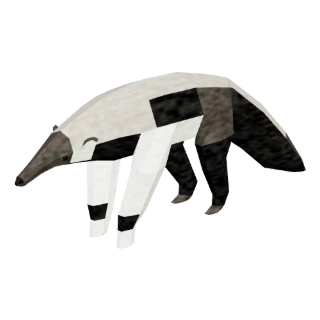
Anteater
Myrmecophaga tridactyla (giant anteater)
MammalIUCN: Vulnerable
The giant anteater has no teeth. It tears open ant and termite nests with huge front claws and slurps up the insects with a sticky tongue about 60 cm long.
🌍 Where does it live?
Grasslands and forests of Central and South America.
🍽️ What does it eat?
Ants and termites, up to about 30,000 a day.
⚠️ Who are its enemies?
Jaguars and pumas.
🦴 Built for its life
A giant anteater has a long, narrow snout, no teeth, a very long sticky tongue and thick fur. Its front claws are so long that it walks on its knuckles to protect them.
🕒 A day in its life
Giant anteaters visit many ant and termite nests but eat only for about a minute at each, so the colony survives and they can come back later. They sleep up to 15 hours a day, covering themselves with their bushy tail.
👪 Family life
A mother has one baby, which rides on her back for months. Its stripe lines up with hers, which makes it hard to see.
💡 Did you know?
- Giant anteaters can eat thousands of ants a day 🐜
- Anteaters have no teeth at all 🦷
- Baby anteaters ride on mom’s back 💗
💬 In its own words
- “My tongue is very long and sticky 👅”
- “I walk on my knuckles to protect my long claws 🐾”
🧠 Quick quiz
❓ How does an anteater eat?
- With sharp teeth
- With a long sticky tongue
- With its tail
✅ Answer: B. With a long sticky tongue
Its tongue can flick in and out up to 150 times a minute.
🔗 Its place in the Wild Valley food web
Watches out for:
 Jaguar
Read more: What is a food chain? · Predators and prey
🎮 In Wild Valley: It lives in these worlds from the start: Jungle. Tap a anteater in the game to see its card, then tap the 📖 book to come back to this page.
Its home habitats: 🌴 Rainforest
🎮 Play Wild ValleyMore mammals to learn about
 Rabbit
 Squirrel
 Bighorn Ram
 Marmot
 Deer
 Fox
 Zebra
 Giraffe
 Elephant
 Gazelle
 Wild Boar
 Bear
Facts are typical values for wild animals from zoo, museum and wildlife-science sources; real animals vary. IUCN = the International Union for Conservation of Nature Red List. Spotted a mistake? Tell us.